Franklin: Syracuse's Air-Cooled Cars, and How They Kept Flying
I spent August 4 at the Gilmore Car Museum in Hickory Corners. After the Model A hall I went into the Franklin building, a replica of Ralph Hamlin’s Los Angeles dealership from around 1918. Hamlin was Franklin’s biggest dealer. The H. H. Franklin Club put its collection there in 2010. The cars inside were built in Syracuse, New York, air-cooled from the first one in 1902 to the last one in 1934. When the factory closed, the engines did not. They went into light planes, helicopters, a flying boat, and then, briefly, into Preston Tucker’s sedan.
This is that story. The Gilmore visit is the rest of the day.
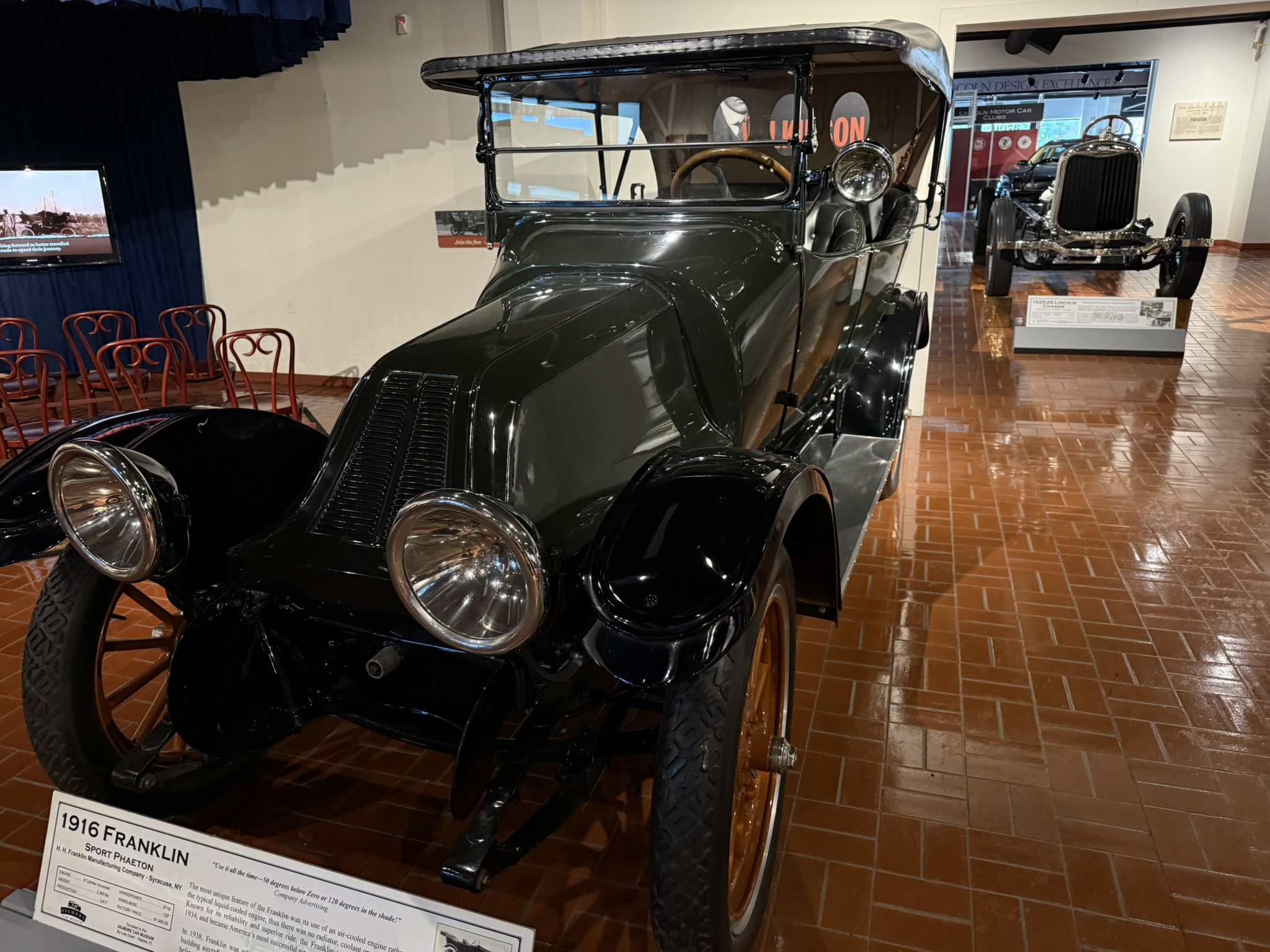
The olive green open car is a 1916 Sport Phaeton. Six cylinders, air-cooled, 25 horsepower, 120-inch wheelbase, $1,950 from the factory. No radiator. The hood is the barrel shape John Wilkinson wanted: louvers on top, because the engine was cooled by air moving over it, not by water in a tank up front.
A Die-Caster and a Cornell Engineer
Herbert H. Franklin started in newspapers, then bought the patents for a die-casting process and moved to Syracuse in 1894. His company made small, precise metal parts. Cars were not the plan.
John Wilkinson was the engineer. Cornell, class of 1889, from a Syracuse family whose grandfather had named the city. He had been putting air-cooled engines on bicycles, then built a four-cylinder automobile without a radiator. Franklin took a ride in it around 1901. In 1902 they reorganized the company around that car.
The first production machine was the Type A, a wooden-framed roadster of about 900 pounds. Thirteen were built that year. S.G. Averell bought one for $1,200 and drove it from Syracuse to New York City. The factory on Geddes Street opened in 1903.
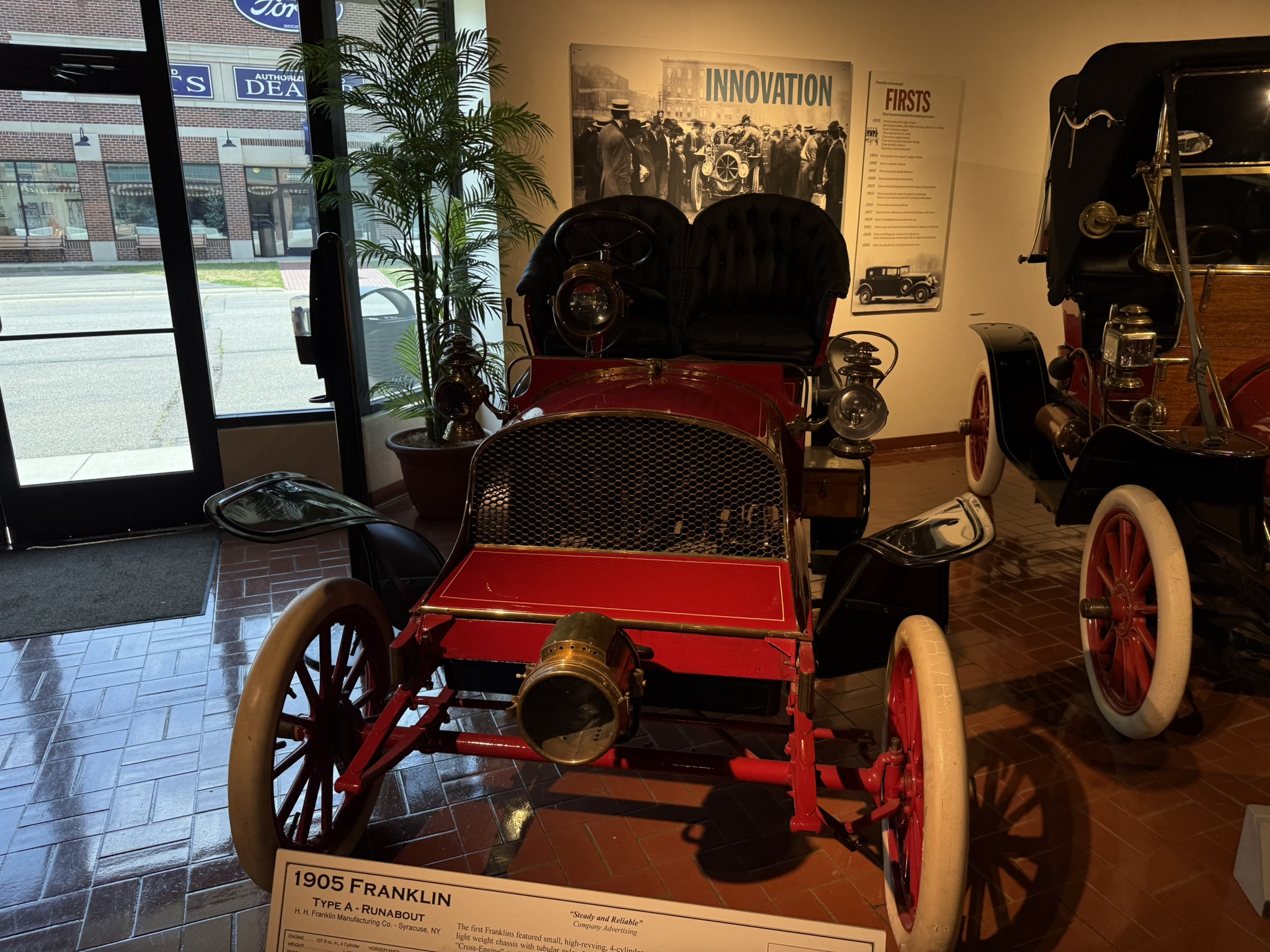
Gilmore has a 1905 Type A Runabout just inside the door, red body, two tufted seats, brass lamps, right-hand drive. Through the window behind it you can see the Ford dealership across the lane. The wall next to it is labeled Firsts and Innovation. Franklin was already selling a four-cylinder air-cooled car when most American makers were still figuring out one cylinder and a water pump.
Why They Looked Like That
Every Franklin was air-cooled. Wilkinson treated weight as a design problem, not a styling one. Most of the cars used wood frames and full-elliptic springs at all four corners. Aluminum showed up everywhere. In the early years the company was said to be the largest user of aluminum in the world.
By 1905 they were building six-cylinder cars. Automatic spark advance followed in 1907. Before antifreeze, an air-cooled engine was a real advantage in a Syracuse winter, and doctors were a natural market: a car that would start on a January morning.
The front end was the other giveaway. Early Franklins wore a barrel, Renault-style hood. There was no radiator to hide, so Wilkinson did not fake one.
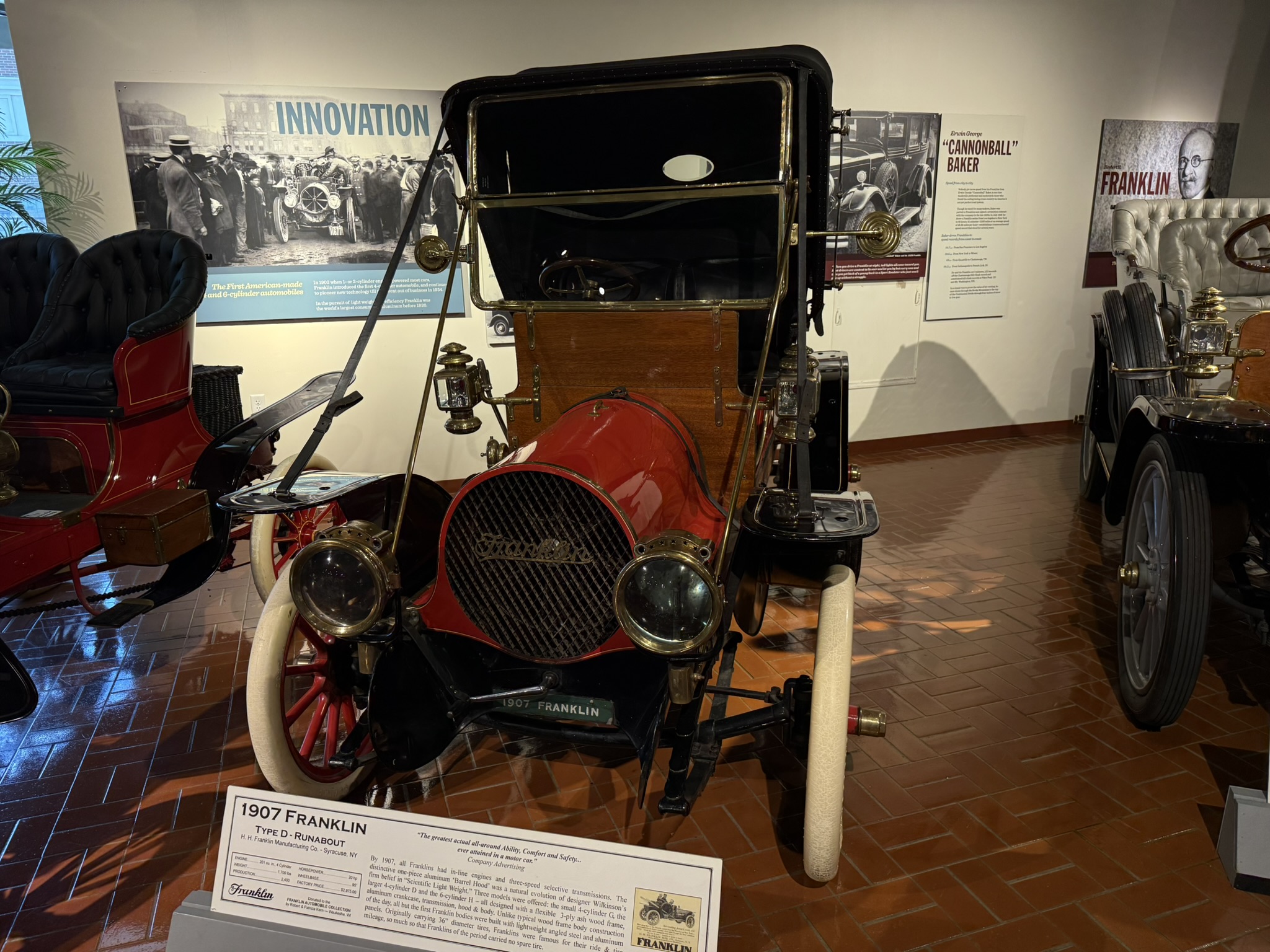
The red 1907 Type D Runabout in the middle of the room is that idea in one car. Four cylinders, 20 horsepower, 105-inch wheelbase, $2,800. The plaque quotes Wilkinson’s phrase for it: scientific light weight. The frame is 3-ply ash, not steel. Dealers hated the look. Customers walking a showroom wanted a car that looked like a Packard. In 1924 Wilkinson was overruled. A false radiator went on. He left.
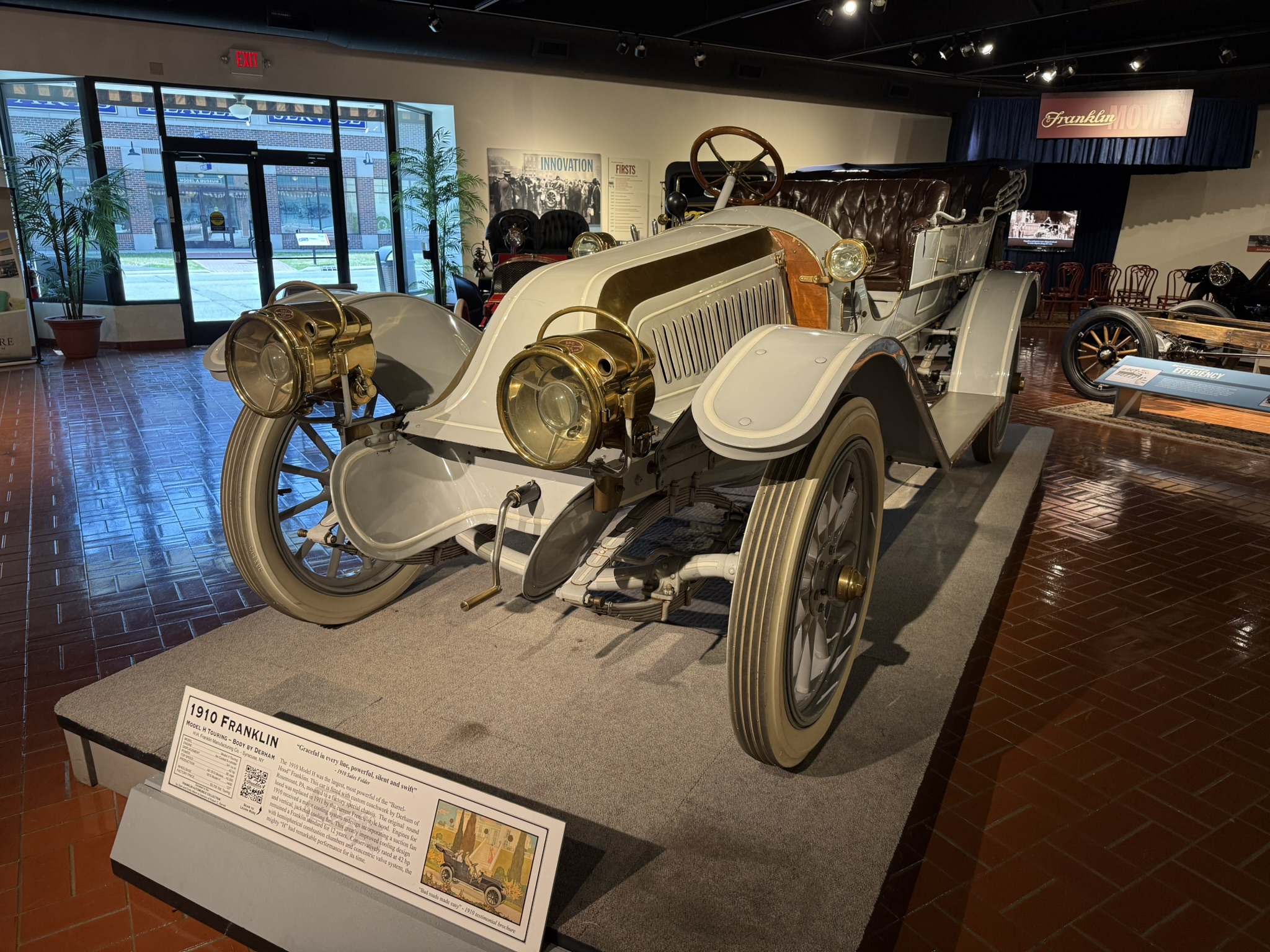
The white 1910 Model H Touring on the plinth is the other end of that barrel-hood line. Body by Derham. The plaque calls it the largest and most powerful of the barrel-hood Franklins, and says this car was once owned by Henry Ford. A 1910 sales folder called it graceful in every line, powerful, silent and swift.
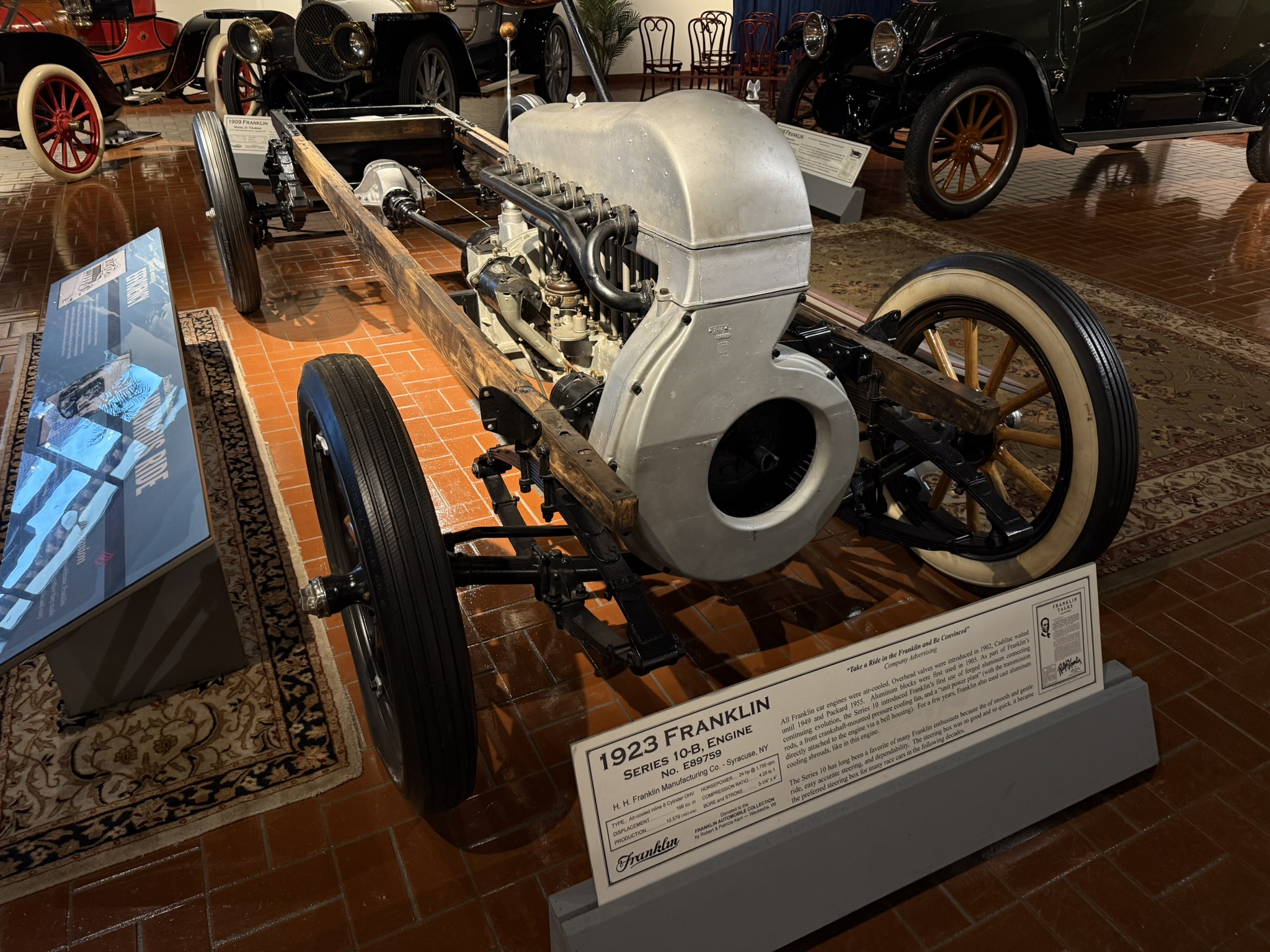
They keep a stripped Series 10-B chassis on the floor so you can see what he was protecting. Engine number E89759, air-cooled inline six, overhead valves, 199 cubic inches, 24 horsepower at 1,700 rpm. Two long wooden rails. A fan and a shroud instead of a radiator and hoses. Franklin built 10,576 of the Series 10-B. This is the part that lasted after the company did not.
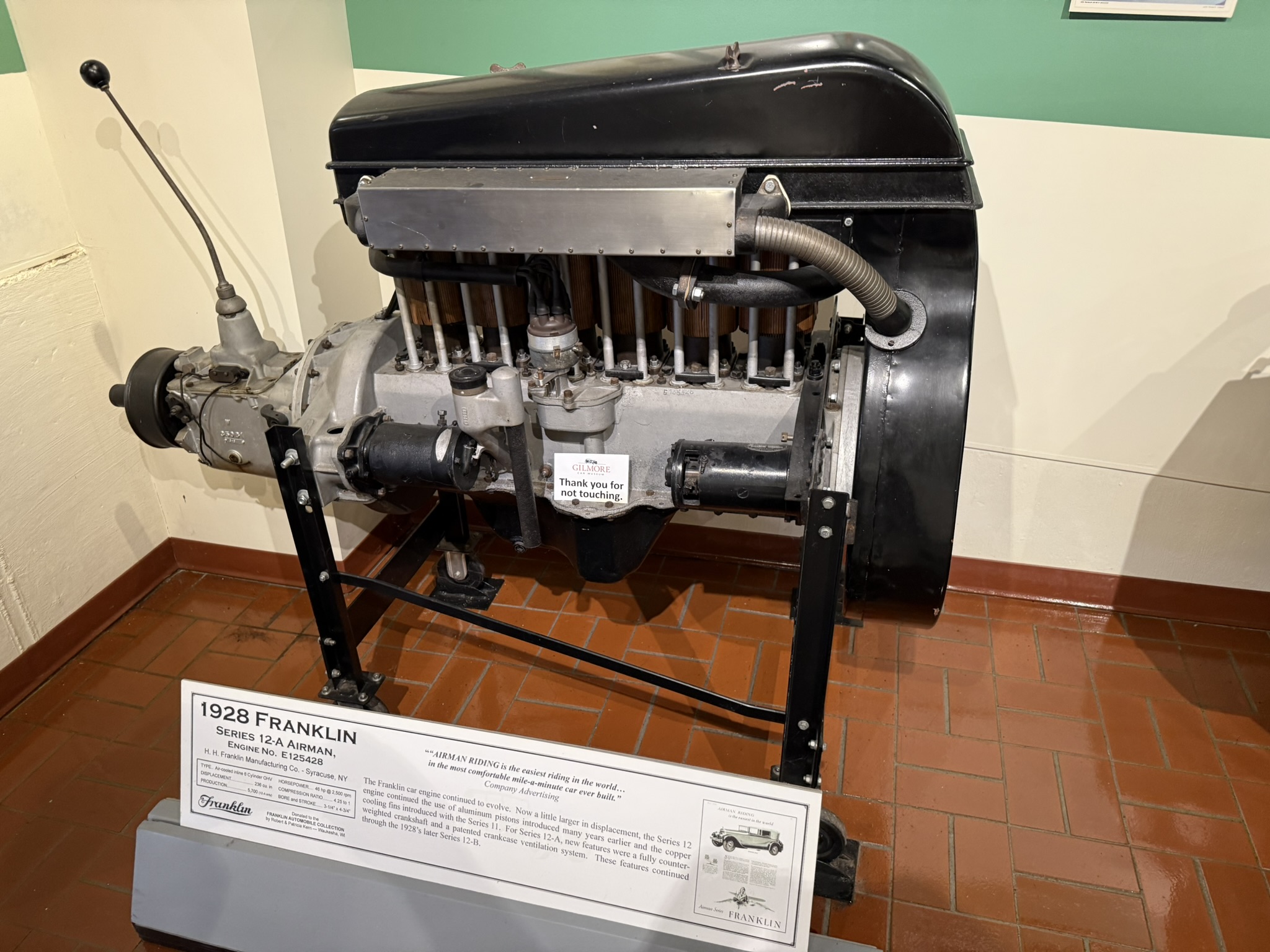
They also stand a 1928 Series 12-A Airman six on a bench. Engine number E125428, 236 cubic inches, 46 horsepower at 2,500 rpm. Aluminum pistons, copper cooling fins, a black shroud over the cylinders, a fan instead of a radiator. Four years after Wilkinson left, the engine was still the point.
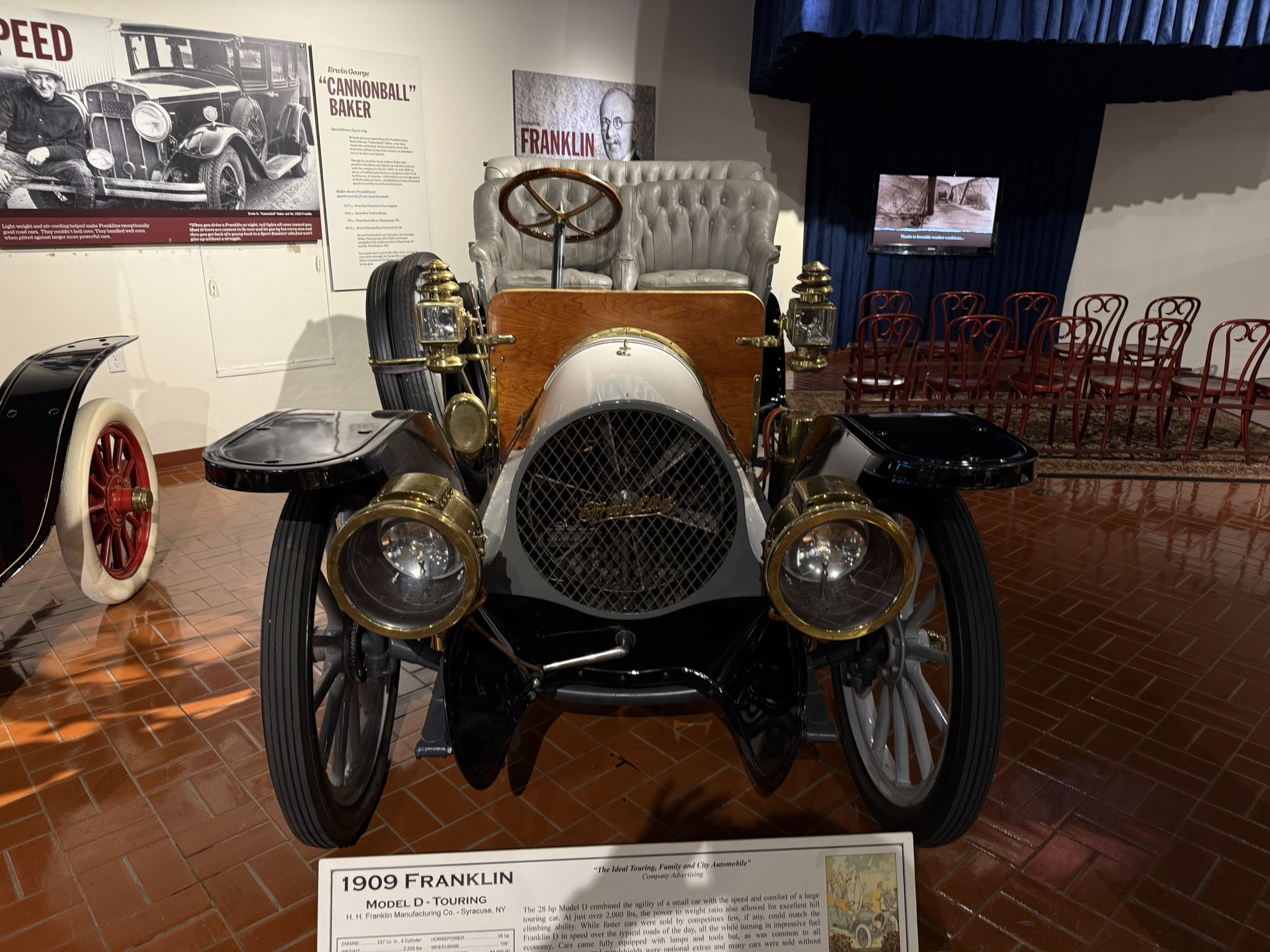
The grey 1909 Model D touring car sits under a wall about Erwin George “Cannonball” Baker. Baker used Franklins for long-distance record runs. Light, air-cooled, and willing to be driven hard on bad roads, which is what Wilkinson had been arguing for since 1902.
The Peak, Then the Crash
Frank De Causse, and later Raymond Dietrich, restyled the cars. They still ran air-cooled sixes. They just looked like other luxury automobiles.
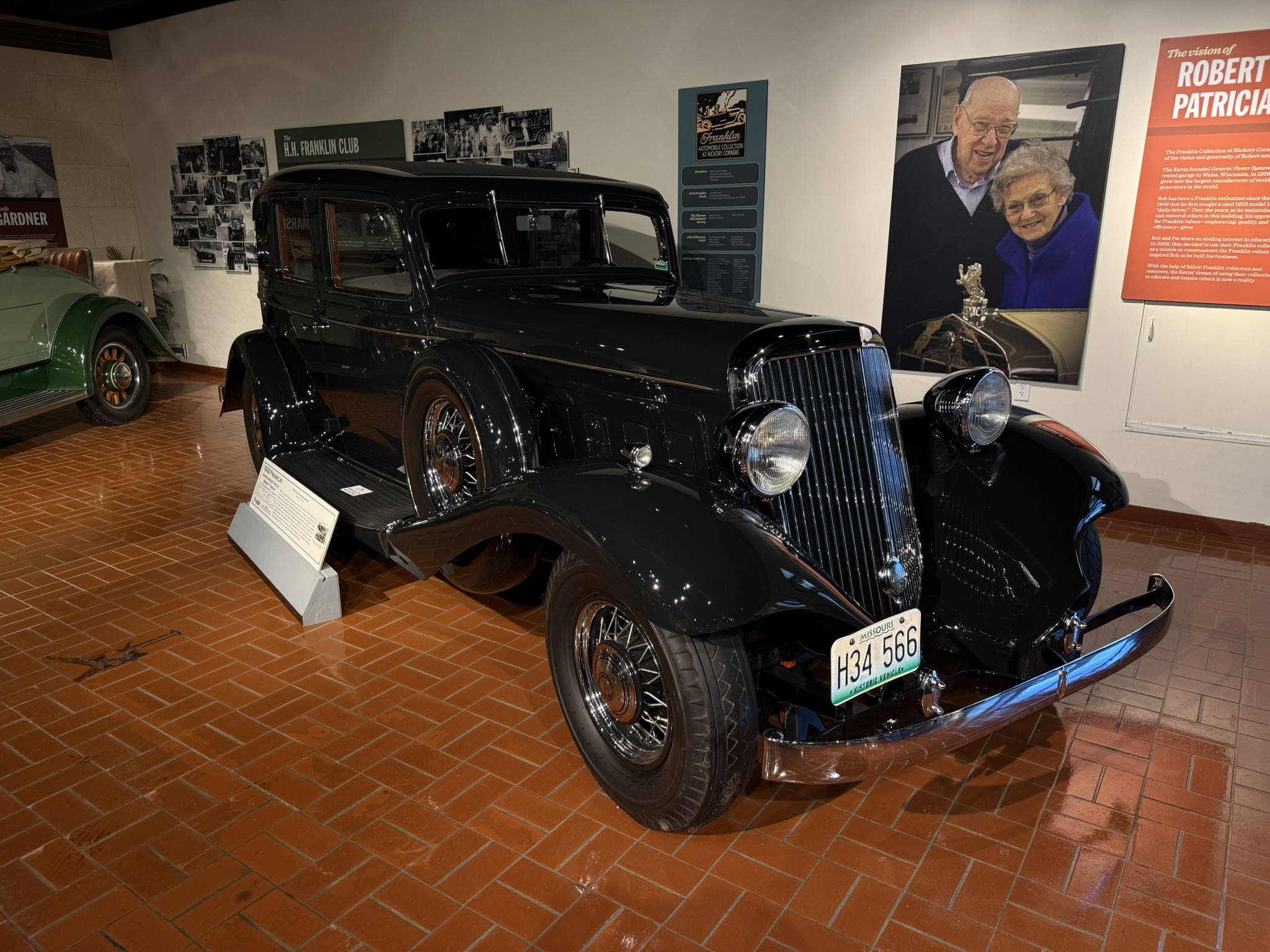
The black 1932 sedan at the back of the room is that later Franklin: upright chrome grille, lion mascot, side-mount spare, a Missouri historic plate. In 1929 the company had its best year, 14,432 cars. The big Model 137 sat on a 132-inch wheelbase, with a 274-cubic-inch Airman six rated at 60 horsepower. Prices ran about $2,770 to $2,970, enough to buy four or five Ford Model A’s. In 1932 Franklin also built the Series 17, the only American production car with an air-cooled V12.
The Depression took the luxury market with it. Franklin had borrowed to expand the Syracuse plant. The last cars left in 1934. About 150,000 Franklins were built in those 32 years. The club estimates roughly 3,700 survive.
The Engineers Stay
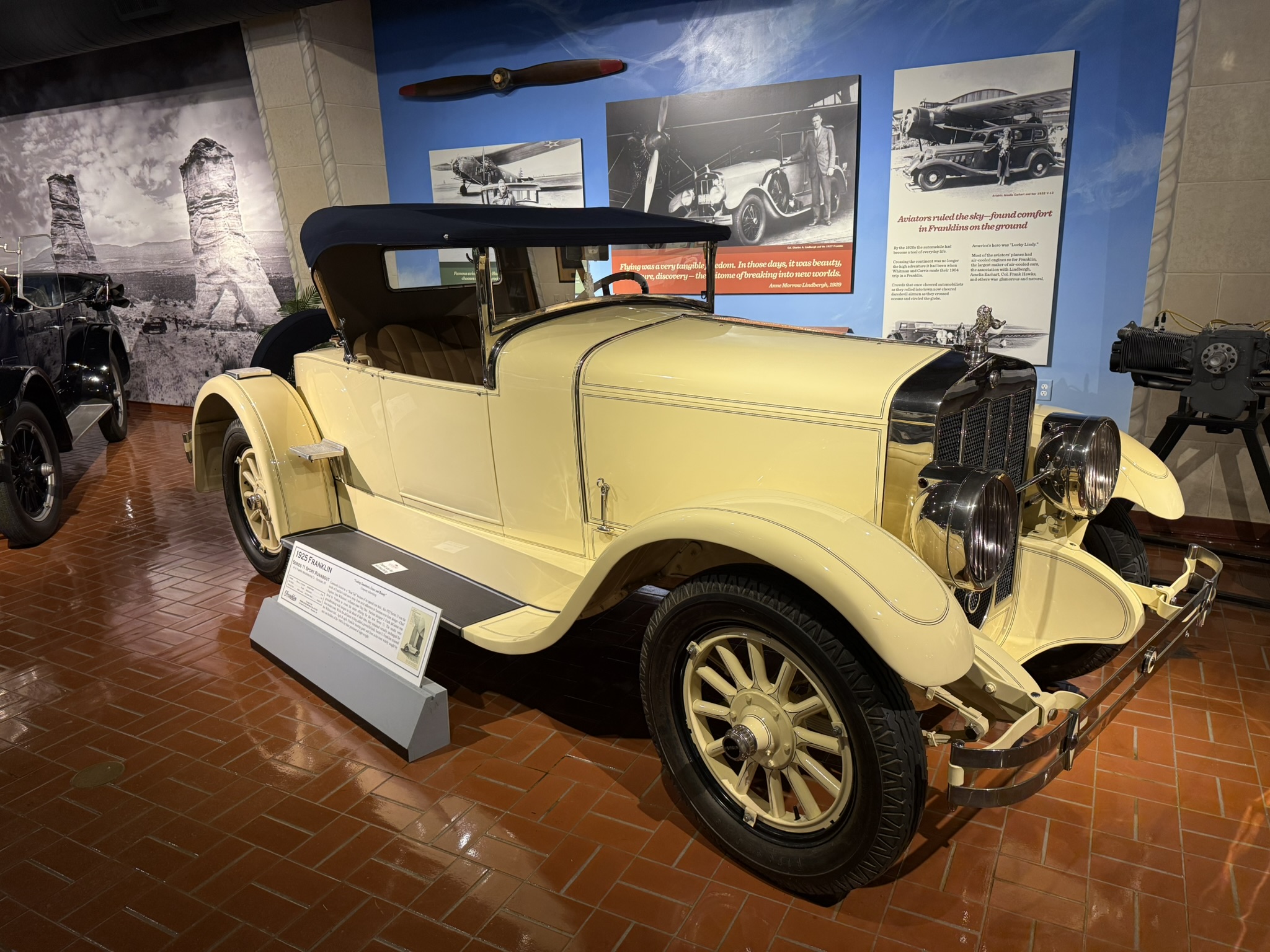
The cream Series 11 Sport Runabout from 1925 sits under a propeller and a wall about aviators who found comfort in Franklins on the ground. The cars already knew where they were going.
Two of them, Carl Doman and Edward Marks, were not done with air cooling. They formed Doman-Marks, built industrial engines, then in 1937 bought the Franklin name and assets and became Aircooled Motors, still in Syracuse. The company name was Aircooled. The engines still said Franklin.
The first successful opposed engines for light planes came out of that shop in the late 1930s. Piper put them in J-3F Cubs. Taylorcraft, Stinson, Aeronca, Culver. Franklin sat with Continental and Lycoming as one of the three names on American light-aircraft engines.
The interesting work was vertical. Versions of the six were mounted on end, with a fan, for helicopters. Bell’s 47 and the Army H-13 used Franklin 6V4 engines, 178 and 200 horsepower. So did the Hiller 360 and H-23 Raven, and Sikorsky’s S-52. For a stretch after the war, if you were building a small American helicopter, you were probably buying Syracuse.
A Flying Boat, Then a Tucker
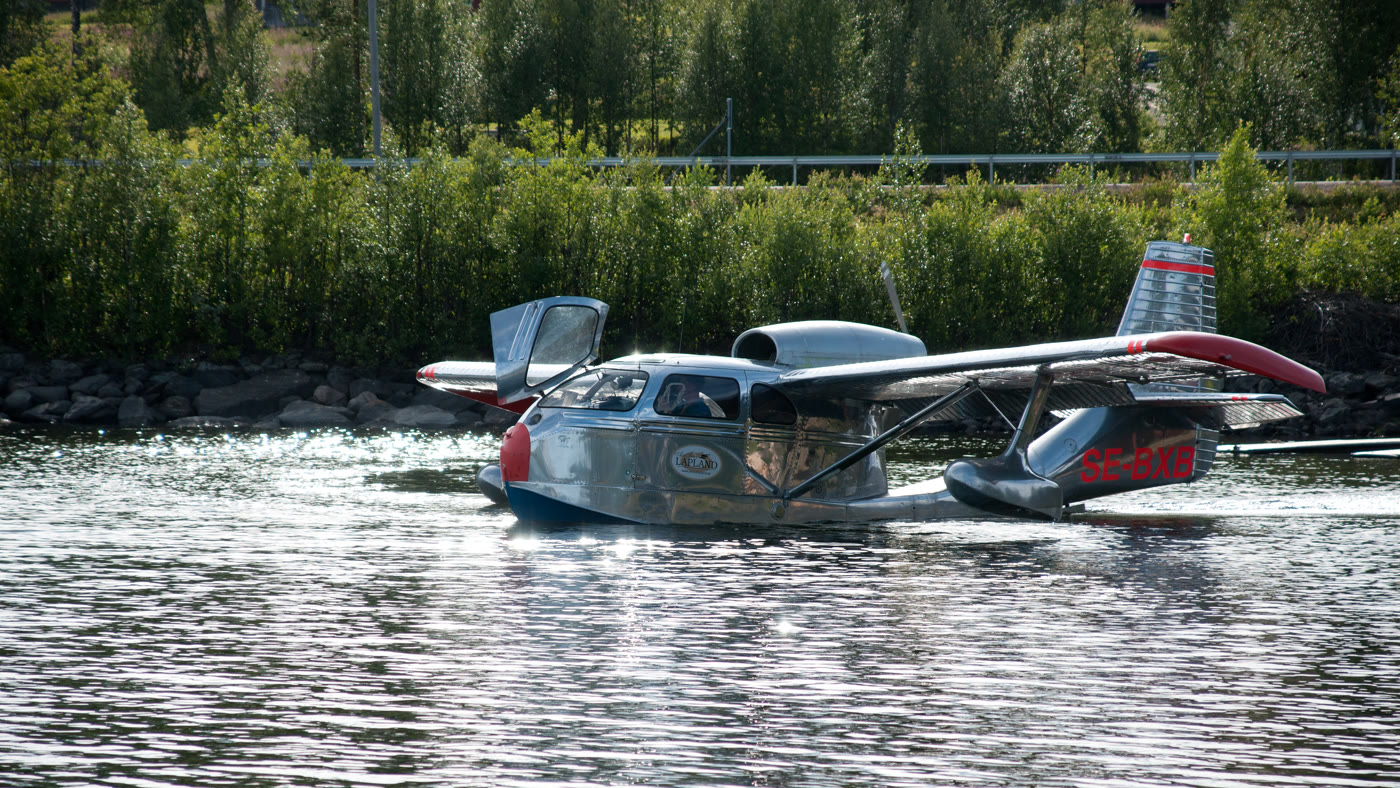
In October 1945 Republic Aviation bought Aircooled to lock down the engine for the RC-3 Seabee, the 6A8-215, about 215 horsepower and 500 cubic inches, sitting backwards in a pusher pod. Republic talked about 5,000 engines. Seabee production stopped in 1947 after 1,060 airplanes.
Tucker bought the company in 1947, the deal closing around March 1948, for about $1.8 million. The 1948 Tucker Sedan needed an engine. Franklin’s O-335 helicopter six, the 6V4-178 and 6V4-200, was converted to liquid cooling and laid down in the car. Tucker cancelled the aircraft contracts so the shop could concentrate on automobiles.
When the Tucker car failed, the engine company almost went with it. It didn’t. Aircooled was the only piece of Tucker that made money in the 1950s. The family held it until 1961, then sold to Aero Industries, which restored the Franklin Engine Company name.
The designs kept moving. Brazil, then in 1975 the Polish state works at Rzeszów, WSK-PZL. Polish production ran into the 1990s and, on some accounts, to 2002. Spare parts, and some new engines, still come out of Poland under the Franklin name. The Aircraft Engine Historical Society keeps the type list.
Where to See One
These photos are from that Hamlin dealership replica at Gilmore, along with engines and the club’s artifacts. The H. H. Franklin Club is the place for the automobile side. For the engines after 1934, start with enginehistory.org.
Franklin is easy to file with the other names that did not survive 1934. The difference is the engines. The same idea Wilkinson put in a 900-pound roadster in 1902, no water, no radiator, as little weight as he could get away with, is what kept a Syracuse shop building helicopter motors into the 1970s. The cars stopped. The air cooling did not.